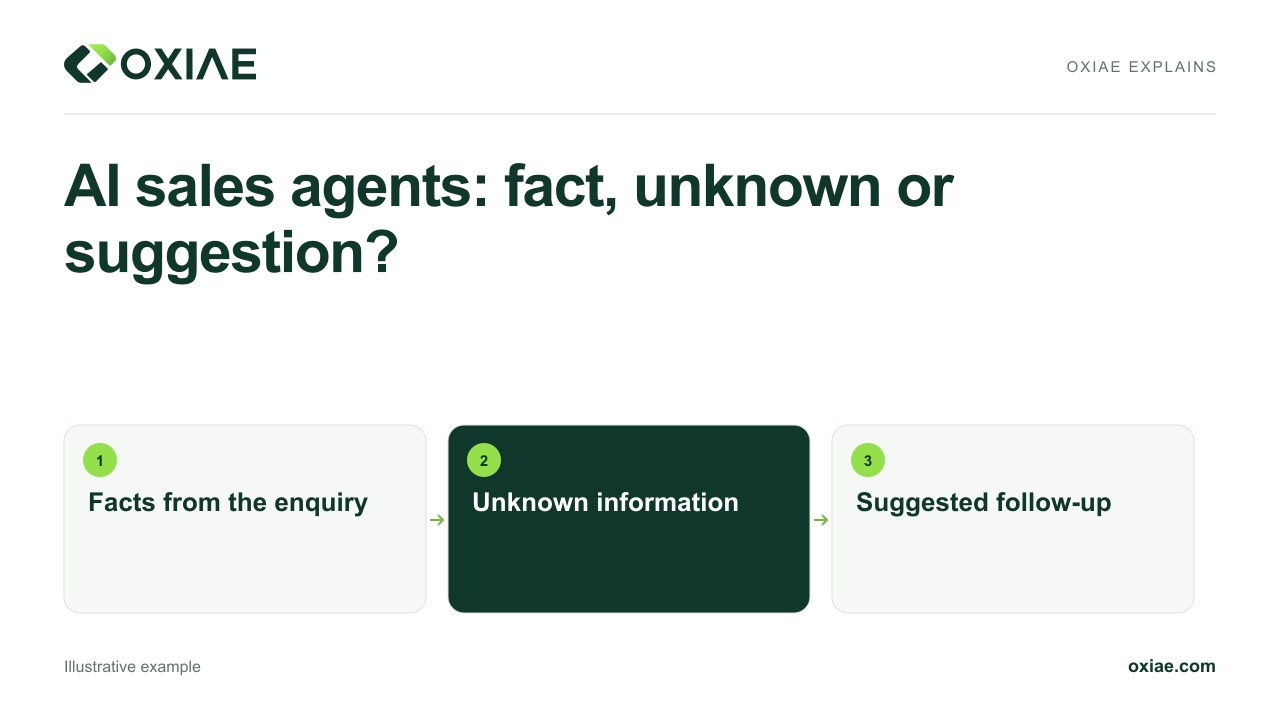
1:51AI sales agents: fact, unknown or suggestion?
Use a fictional sales enquiry to see how an AI agent separates facts, unknown information and suggested next steps while a salesperson retains the decision.
Source articleAI sales agentFollow a fictional project assistant as it gathers information and prepares a proposal, with restricted tools, explicit permissions and a clear stopping point.
The spoken explanation, organised by chapter.
An AI agent can choose next steps, but its authority needs clear boundaries first.
A fictional company wants two software packages connected. A project assistant may look up customer details, identify missing information and prepare a follow-up question. It may not commit to a quotation or send a customer message.
Describe the information the agent receives, the tools it may choose and when its work is complete. Here, a finished draft is the endpoint, rather than a project sold without human involvement.
The application checks every requested system action. Telling a prompt not to send messages is not access control. Give the integration only the permissions required for this particular task.
If the sequence is always fixed, an ordinary workflow may be simpler. An agent becomes worth investigating when the next step genuinely depends on information found during the task.
If a source is missing or an instruction requests a forbidden action, the agent stops or asks for review. Bound time, cost and action counts too, so an unclear assignment cannot run indefinitely.
Try normal requests, missing information and messages that attempt to change the task. Check that forbidden actions are blocked and that proposals reach the designated reviewer for an explicit decision.
Choose one task, representative examples and a responsible staff member. Assess the output and actions taken before adding tools or granting wider authority.
Read OXIAE’s guide to building AI agents with explicit permissions, tests and human oversight.