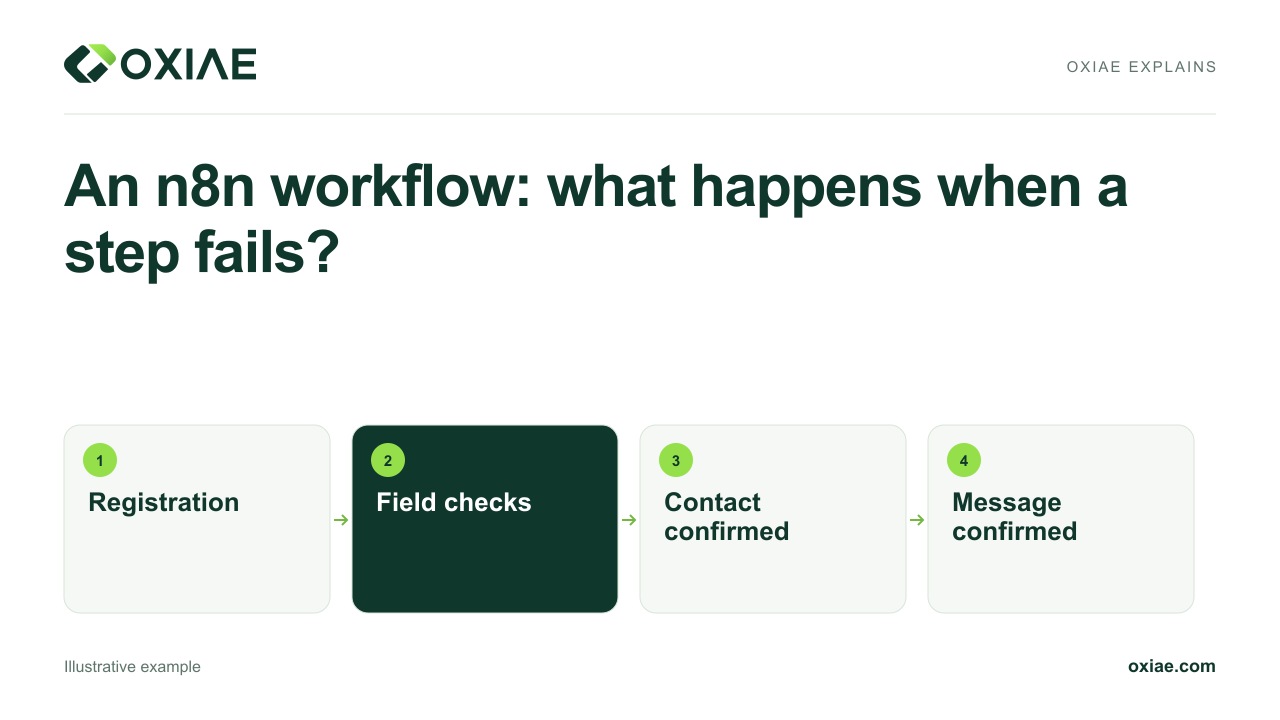
1:44An n8n workflow: what happens when a step fails?
Follow a fictional registration through an n8n workflow and see why visible failures, stable references and controlled recovery matter to daily operation.
Source articlen8n consultingAn illustrative CRM request shows how an API integration handles repeated messages, invalid fields and a timeout whose outcome has not yet been established.
The spoken explanation, organised by chapter.
This accompanies our article on API integration. What if a system resends a message after the first order was created?
A fictional approved CRM request goes to an administration system. Its message arrives twice. Without a stable reference, two draft orders could represent exactly the same request.
Assign an immutable source reference and store it in the destination. A mapping table connects the customer reference with the correct existing customer number in the administration system.
Only approved requests proceed. Validate required text, customer mapping and date format. A missing match or invalid date stops processing and receives an explicit error reason for follow-up.
Searching first does not prevent duplicates when messages run concurrently. The destination must enforce a unique external reference even when two processing attempts start at the same time.
After a timeout, the order may exist. Check the destination using that reference first. If the outcome remains unknown, request human review before attempting to create another order.
Record source reference, processing status and error reason. An administrator needs to identify completed work and outstanding exceptions without blindly repeating the whole integration from the beginning.
Test repeated and concurrent messages, missing fields and uncertain outcomes. Check current source status too: an old message must not reverse a newer state in the destination.
A dependable integration needs more than a successful transfer. Our source article on API integration explains data agreements, error responses and controlled reprocessing in greater detail.